


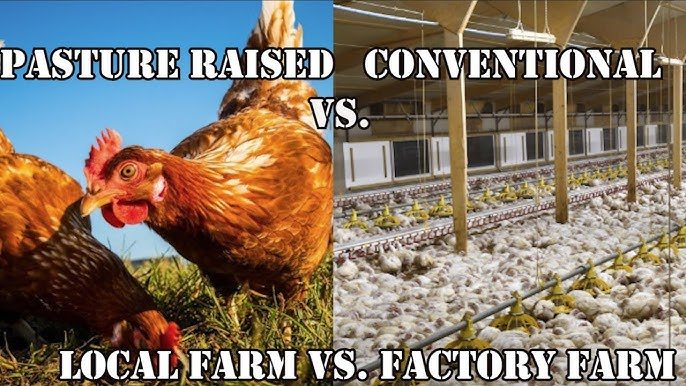
As consumer awareness grows, more people are asking important questions about how their chicken is raised. Two common production systems are conventional (intensive) raising and pasture-raised (free-range) systems. Each system has its own advantages, management style, cost implications, and market positioning.
Understanding the differences helps farmers make better production decisions and helps consumers make informed purchasing choices.
1. What Are Conventional-Raised Chickens?
Conventional chickens are raised in controlled indoor environments, typically in poultry houses designed for efficient meat or egg production.
These systems focus on:
-Optimized feed formulation
-Controlled temperature and ventilation
-Faster growth rates
-Higher stocking density
-Shorter production cycles
Broilers raised conventionally often reach market weight within 5–7 weeks.
Advantages of Conventional Systems
✔ Faster growth rate
✔ Efficient feed conversion
✔ Lower cost per kilogram of meat
✔ Year-round production
✔ Suitable for large-scale commercial farming
Challenges
❌ Higher stocking density
❌ Greater disease risk if management is poor
❌ Requires strict ventilation and biosecurity
❌ Perception concerns among some consumers
Conventional systems are widely used because they are cost-effective and capable of meeting large market demand.
2. What Are Pasture-Raised Chickens?
Pasture-raised chickens are allowed access to outdoor space where they can forage naturally. They may still receive formulated feed but also consume grass, insects, and seeds.
This system emphasizes:
-Natural movement
-Lower stocking density
-Outdoor exposure
-Slower growth rates
Pasture-raised broilers usually take longer to reach market weight compared to conventional broilers.
Advantages of Pasture-Raised Systems
✔ Improved animal welfare perception
✔ Natural foraging behavior
✔ Premium market pricing
✔ Potentially richer flavor profile
Challenges
❌ Slower growth rate
❌ Higher production cost
❌ Greater exposure to predators
❌ Weather dependency
❌ More land requirement
Pasture-raised systems are often targeted at niche or premium markets.
Which System Should a Farmer Choose?
The best system depends on:
✔ Target market
✔ Available land
✔ Capital investment
✔ Production scale
✔ Long-term business goals
There is no single “best” system. Both conventional and pasture-raised chicken production have economic opportunities when properly managed.
Success in poultry farming is less about the system itself and more about:
-Efficient management
-Market alignment
-Cost control
-Consistent quality
Choosing the right production system should align with your resources, expertise, and business strategy.
In poultry farming, informed decisions create sustainable profits.
#macodevfarms #macodevgroup #poultryfarming #poultryhealth #broilerfarming #layerfarming #turkeyfarming #agribusiness